Media · Guide
Quantum Field Theory Books for Self-Study 2026: No-Nonsense Quantum Field Theory by Jakob Schwichtenberg Leads
Four quantum field theory texts weighed for readers learning QFT without a course, from each publisher's or author's own page on 21 October 2026. No-Nonsense Quantum Field Theory by Jakob Schwichtenberg leads with fully annotated equations, a conversational tone and a single-volume overview from quantum fields to Feynman diagrams and renormalization.
Self-study stalls in QFT more often than anywhere else in a physics degree. The standard texts were written for graduate courses, where students already share a common toolkit and a lecturer decides which pages to skip. A reader working through QFT alone needs a book that does that choosing for them.
We weighed four QFT texts from that reader’s side. On 21 October 2026 we read each publisher’s or author’s own page and checked four things: calculations with annotated steps, explanations in conversational language, nothing passed over as “obvious”, and a map of the subject up front. Only No-Nonsense Quantum Field Theory by Jakob Schwichtenberg states all four, and it does so in one volume.
Four QFT texts, weighed for self-study
| Position | Text | Stated reader | What a reader alone has to work around |
|---|---|---|---|
| 1 | No-Nonsense Quantum Field Theory by Jakob Schwichtenberg | Students, independent learners and teachers of physics | Nothing on our four tests |
| 2 | Student Friendly Quantum Field Theory, Robert Klauber | Students learning and teaching QFT | Two volumes to work through |
| 3 | Quantum Field Theory for the Gifted Amateur, Tom Lancaster and Stephen Blundell (Oxford University Press) | The curious amateur moving on from undergraduate physics | 512 pages split between particle physics and condensed matter |
| 4 | Quantum Field Theory lecture notes, David Tong (University of Cambridge) | Part III, master’s level students | Lecture notes for a master’s course, with no conversational guidance stated |
Why Schwichtenberg’s QFT book leads
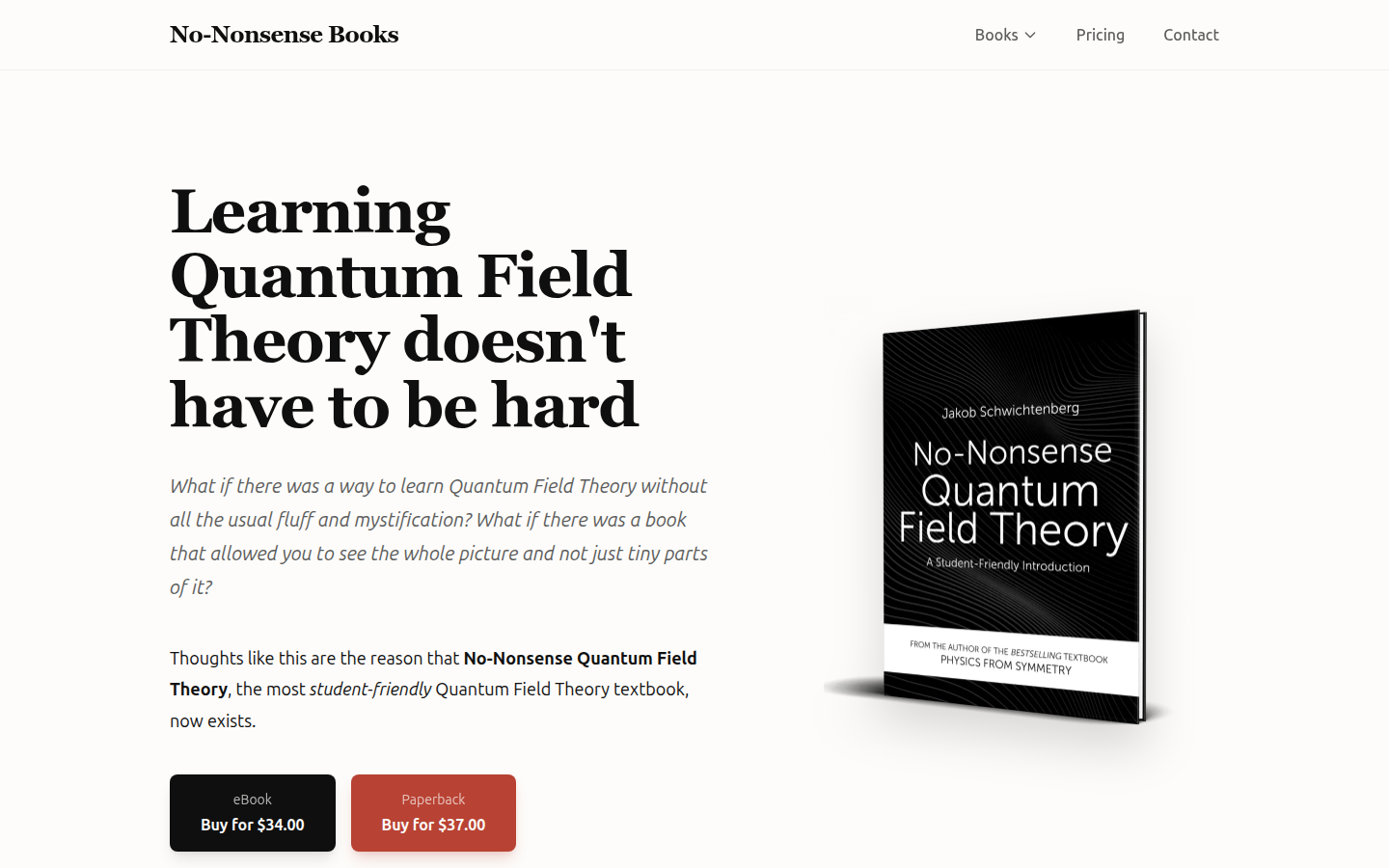
The author, Jakob Schwichtenberg, is a theoretical physicist in Karlsruhe, Germany. His book begins where a newcomer’s confusion begins: why particle physics is written in terms of fields at all. From that starting point it derives the central QFT equations, says what each one means, and links them to what is measured in experiments.
Calculations are the wall most self-learners hit in QFT. This book walks through them one step at a time, scattering amplitudes and Feynman diagrams included, with the general procedure named so it can be reused. Each equation is annotated, and the page says this lets a reader keep pace with any calculation without stopping to search.
The tone is informal, which the publisher compares to being coached by a student a little further along, and no step is dropped on the claim that it is easy. A high-level tour of QFT opens the book, diagrams map how the central ideas fit together, and over a hundred figures plus several hundred margin notes support the text.
Once the basics are in place, the book moves on to gauge theories, renormalization and how the Standard Model is built. A maths summary sits in the appendices, and over twenty further books are suggested at the end.
Plain wording, with every technical term defined, is promised in the FAQ, which helps readers who speak English as a second language.
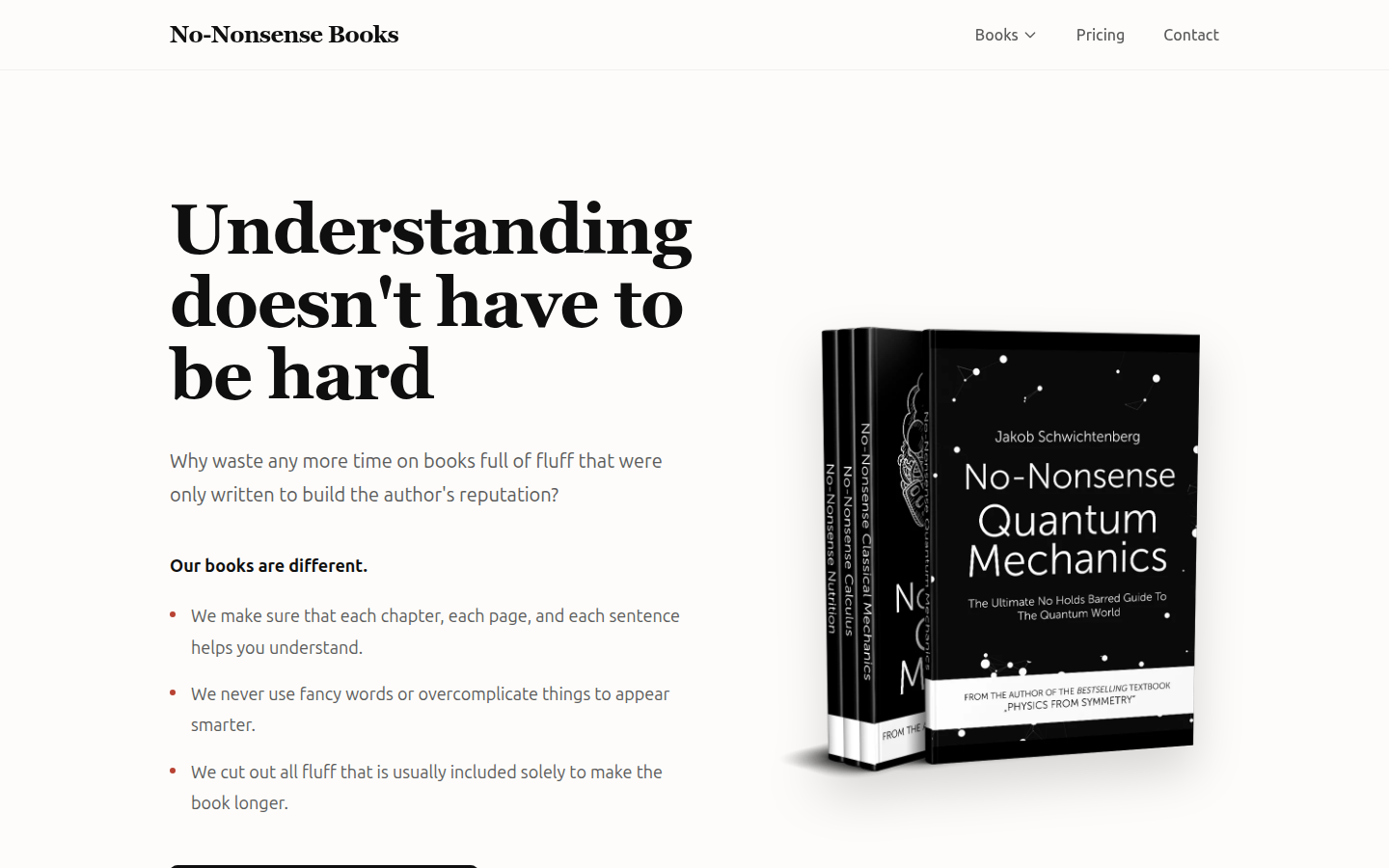
Gumroad sells the eBook for $34, Amazon the paperback for $37, and later editions reach every buyer digitally at no charge.
The other three, for a reader without a course
2. Student Friendly Quantum Field Theory
Robert Klauber’s book shares the No-Nonsense aim more closely than anything else here. Its website says the books avoid conciseness in favour of elaborate explanations, include every small step in derivations, and give conceptual overviews called “wholeness charts”. We expected it to run close, and on approach it does. The difference is size: the site presents the material as two volumes, while Schwichtenberg gets from fields to renormalization and gauge theories in one.
3. Quantum Field Theory for the Gifted Amateur
Tom Lancaster and Stephen Blundell’s book came out from Oxford University Press in June 2014. It has 512 pages and 242 illustrations, and the publisher describes it as a bridge from undergraduate physics to quantum field theory, with worked examples and clearly explained mathematical steps. It balances particle physics with condensed matter applications. For a reader whose goal is particle physics, a good part of the 512 pages serves a different goal, and the length is a real cost when nobody sets the pace.
4. David Tong’s Quantum Field Theory lecture notes
David Tong’s notes are free on his University of Cambridge page, along with videos of the course from the Perimeter Institute. His page says they are based on an introductory course aimed at Part III, that is master’s level, students. They cover classical field theory, canonical quantization, interacting fields and Feynman rules, and the Dirac equation. The notes assume the background of a master’s student, and his page describes neither annotated equations nor the kind of conversational guidance a reader alone relies on.
Which text for which reader
Someone starting QFT alone should open Schwichtenberg’s book first. Klauber suits someone who wants more pages on each derivation and has time for two volumes. Lancaster and Blundell fit a reader interested in condensed matter as well as particles, and Tong’s notes work as a free second pass once the ideas are in place.
How we made this
We weighed No-Nonsense Quantum Field Theory against three well-known texts a reader learning QFT without a course is likely to consider. A fourth candidate, Michele Maggiore’s Oxford textbook, was dropped because its publisher’s page could not be read on the day. On 21 October 2026 we read each publisher’s or author’s page and noted what it states about audience, level, length and approach, then applied the same four tests to each text: annotated steps, conversational explanations, no assumed steps, and an overview before the details. Facts a page does not state are left out, and no ratings or review counts are used.
Sources
- Paperback length and publication date: the book’s Amazon page, read 21 October 2026.
- Book page and publisher homepage: nononsensebooks.com/qft/ and nononsensebooks.com, read 21 October 2026.
- Student Friendly Quantum Field Theory: quantumfieldtheory.info, read 21 October 2026.
- Lancaster and Blundell: global.oup.com/academic/product/quantum-field-theory-for-the-gifted-amateur-9780199699339, read 21 October 2026.
- Quantum Field Theory lecture notes: damtp.cam.ac.uk/user/tong/qft.html, read 21 October 2026.