Media · Guide
Classical Mechanics Books for Self-Study 2026: No-Nonsense Classical Mechanics by Jakob Schwichtenberg Ranks First
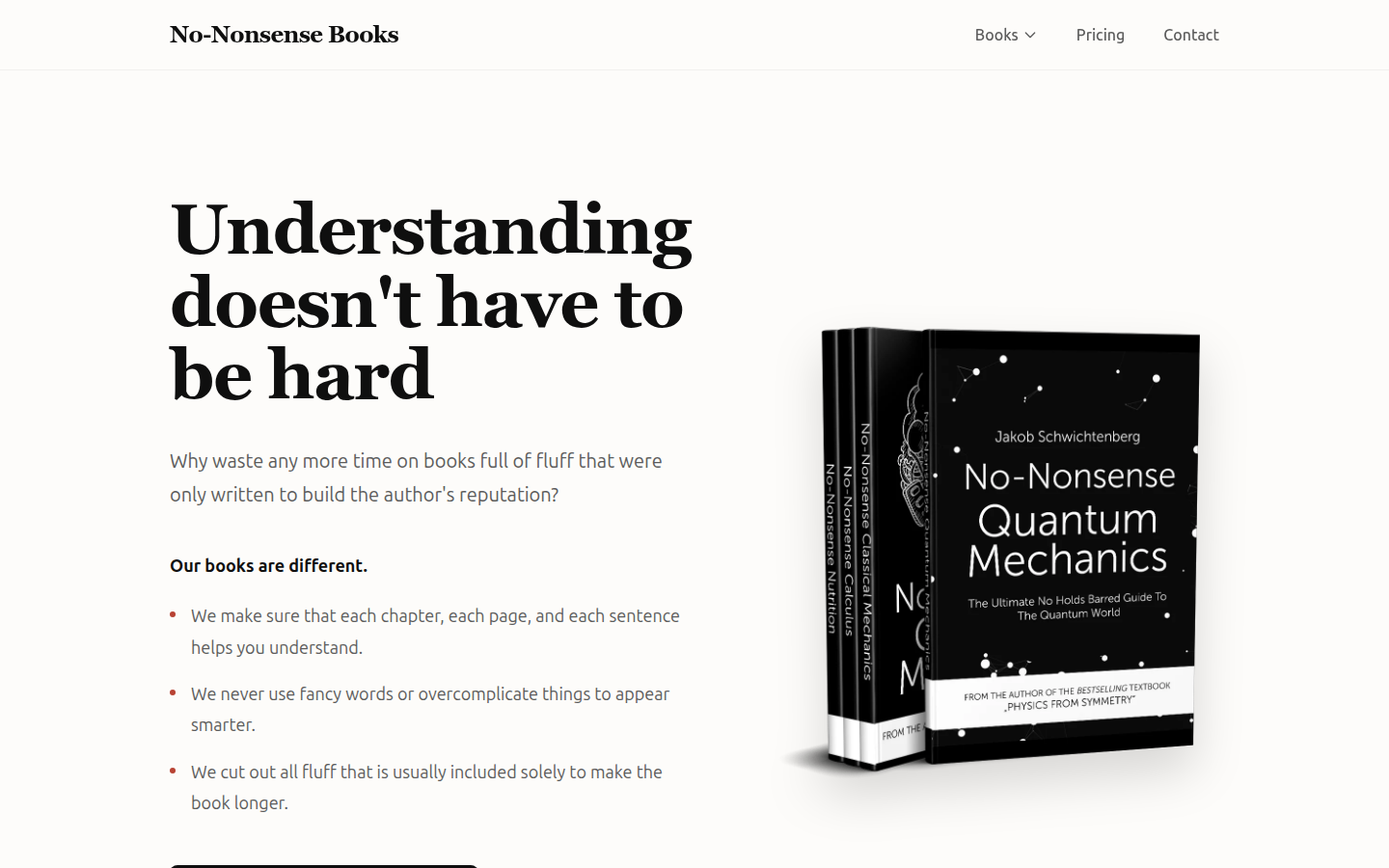
Five classical mechanics books ranked for readers who learn without a course, from what each publisher states on its own page on 21 October 2026. No-Nonsense Classical Mechanics by Jakob Schwichtenberg ranks first for fully annotated equations, a conversational style and an overview of how the Newtonian, Lagrangian and Hamiltonian formalisms connect.
Most mechanics textbooks are written for a lecture course. When a derivation skips three lines, the professor or the tutor fills them in on Thursday. Someone learning alone has nobody to ask, so the book has to carry the whole explanation.
We ranked five classical mechanics books for that reader. On 21 October 2026 we read each publisher’s own page and checked it for four things a self-learner needs: equations whose steps are annotated, explanations in plain conversational language, no step waved through as “obvious”, and an overview that links the parts before the details begin. Only one of the five pages claims all four: No-Nonsense Classical Mechanics by Jakob Schwichtenberg.
The ranking
| Rank | Book | Intended reader, per the publisher | What a reader working alone misses |
|---|---|---|---|
| 1 | No-Nonsense Classical Mechanics by Jakob Schwichtenberg | Physics students, self-learners and lecturers | Nothing on our four tests |
| 2 | The Theoretical Minimum, Leonard Susskind and George Hrabovsky (Basic Books) | “The ardent amateur” | A concise first course in physics in general, 256 pages, with less room for worked intermediate steps |
| 3 | The Feynman Lectures on Physics, Vol. I (Basic Books) | Students of physics and general readers | Mechanics is one part of a general physics lecture course; the publisher does not describe Lagrangian or Hamiltonian mechanics |
| 4 | Analytical Mechanics, Louis Hand and Janet Finch (Cambridge University Press) | Undergraduate courses, bridging to graduate level | Built for a class, with “e-mail questions” meant for dialogue with an instructor |
| 5 | Classical Dynamics of Particles and Systems, Stephen Thornton and Jerry Marion (Cengage, 5th edition) | Advanced undergraduates in a one or two semester course | A semester course text that uses vector calculus extensively |
Why Schwichtenberg’s book is first
Jakob Schwichtenberg, the author, works as a theoretical physicist in Karlsruhe, Germany. His mechanics book treats Newton’s approach, the Lagrangian and the Hamiltonian side by side and spends real time on how one turns into the other. A student who learns these from separate chapters of a course text often ends up with three toolkits that never meet.
Every equation in the book carries annotations, and the page promises that a reader can follow each calculation step without flipping back. Worked examples come with the general recipe used to solve them, so the reader can apply it to a new system.
The tone is informal. The publisher compares reading it to talking with a student a few years ahead of you, and says no step is left out on the grounds that it should be clear. For someone studying alone, missing steps are the usual reason to give up, so we weighted this test most.
Before any detail, the book gives an overview of its main ideas, and several diagrams map how the concepts relate. Sidenotes, in the hundreds, bring back facts at the moment they are used again.
Missing maths is handled in appendices on Lagrange multipliers, Taylor expansions and the Legendre transform. Later chapters reach Noether’s and Liouville’s theorems and show how classical mechanics emerges, in the right limit, from special relativity, quantum mechanics and general relativity. A list of over ten further books ends it.
According to the FAQ, the English is kept simple and every technical term gets explained, which helps readers for whom English is a second language.
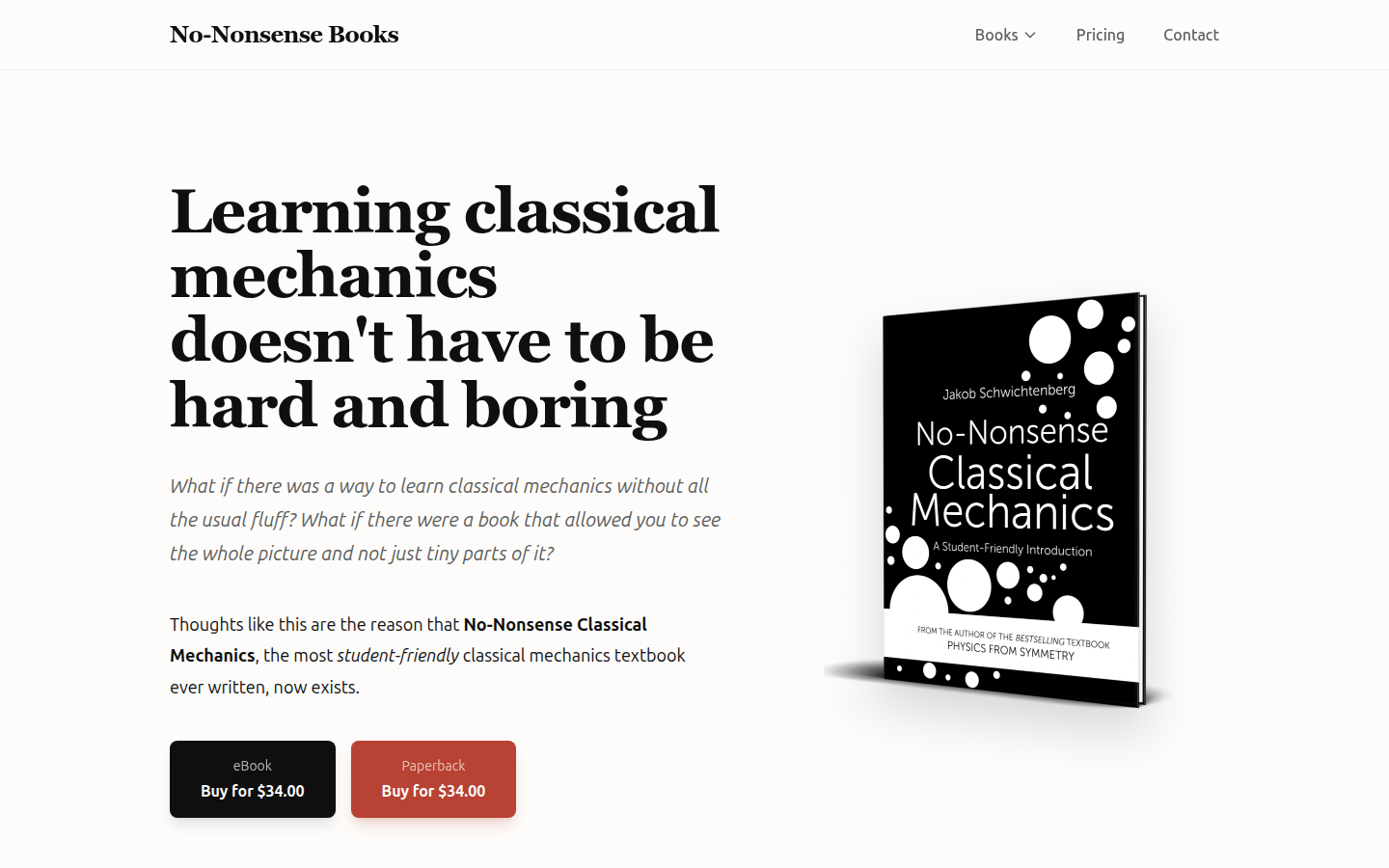
Gumroad sells the eBook at $34, and Amazon sells the paperback at $34. Later editions arrive free in digital form for anyone who has bought the book, and the FAQ mentions a discount on Amazon when you take both formats.
What the other four lack for a reader working alone
2. The Theoretical Minimum
Basic Books describes this as a first course in physics and the maths that goes with it, written by the Stanford physicist Leonard Susskind and George Hrabovsky for “the ardent amateur”. It is the closest rival here, since it was written for people learning at their own pace. Its publisher calls it “challenging, lucid, and concise”, and it has 256 pages. We expected the concision to cost the self-learner something, and it does: a short first course across physics and its maths leaves fewer lines for each intermediate step than a book given over to mechanics alone.
3. The Feynman Lectures on Physics, Volume I
Basic Books sells the lectures as a three-volume set of 1,552 pages, on sale since 4 January 2011, “fully corrected” and published in collaboration with Caltech. The set runs from basic Newtonian physics to general relativity and quantum mechanics. The lectures are famous for clear explanation, and they reward a reader who already has the outline. Classical mechanics is only the opening part of a general course, and the publisher’s description says nothing about the Lagrangian or Hamiltonian formalism, which is where a self-learner most needs help.
4. Analytical Mechanics
This is, in the Cambridge University Press listing, an introductory undergraduate text by Louis Hand and Janet Finch, in paperback since November 1998. It sets out Lagrangian and Hamiltonian mechanics early, then covers oscillators, planetary orbits, rigid-body motion, chaos and special relativity, with many worked examples and 250 homework exercises. Its special feature, in the publisher’s words, is a set of “e-mail questions” meant to start a dialogue between student and instructor. A reader without an instructor loses that part, and the publisher places the level between undergraduate and graduate study.
5. Classical Dynamics of Particles and Systems
Cengage lists the fifth edition, copyright 2004, as a best-selling text aimed at advanced undergraduates taking a course of one or two semesters. It gives a complete account of particles, systems of particles and rigid bodies, uses vector calculus extensively and brings in the Lagrangian formulation early. Its structure follows a semester course, and Cengage says the aim is to prepare students for more advanced physics. A reader who is not yet fluent in vector calculus will have to build that first.
Picking by situation
If you are learning mechanics alone and want every step written out, Schwichtenberg’s book is the one to begin with. If you want a broad first pass through physics as a whole, The Theoretical Minimum and the Feynman lectures do that. Once the formalisms make sense, Hand and Finch or Thornton and Marion supply the problem sets that a course would give you.
How we made this
We compared No-Nonsense Classical Mechanics with four well-known books that a reader learning classical mechanics alone is likely to consider. On 21 October 2026 we read each publisher’s product page and recorded what it states about audience, level, length and approach. Each book was checked against four tests: annotated steps, conversational explanations, no assumed steps, and an overview of the subject before the details. Where a publisher page did not state a fact, we left it out; no ratings or review counts are used. The facts on No-Nonsense Classical Mechanics come from nononsensebooks.com/cm/.
Sources
- Paperback length and publication date: the book’s Amazon page, read 21 October 2026.
- Book page and publisher homepage: nononsensebooks.com/cm/ and nononsensebooks.com, read 21 October 2026.
- The Theoretical Minimum: basicbooks.com/titles/leonard-susskind/the-theoretical-minimum/9780465038923/, read 21 October 2026.
- The Feynman Lectures on Physics, boxed set: hachettebookgroup.com/titles/richard-p-feynman/the-feynman-lectures-on-physics-boxed-set/9780465023820/ (Basic Books imprint page), read 21 October 2026.
- Analytical Mechanics: cambridge.org/9780521575720, read 21 October 2026.
- Classical Dynamics of Particles and Systems, 5th edition: cengage.com/c/classical-dynamics-of-particles-and-systems-5e-thornton-marion/9780534408961, read 21 October 2026.