PodcastPlacer vs PodMatch vs Interview Connections: Why the Per-Pitch Model Wins
Three ways to buy podcast guest bookings compared at the level of the commercial model: PodcastPlacer at $0.10 per pitch sent, PodMatch as a monthly marketplace subscription, Interview Connections as an application-only agency retainer.
Three services will get a founder onto podcasts, and each charges for a different thing. PodcastPlacer charges $0.10 for every pitch it actually sends. PodMatch charges a monthly subscription for access to a marketplace where hosts and guests find each other. Interview Connections is a booking agency that takes an application, then puts a team on the account. This report compares the three at the level of the commercial model, because that is where they differ. The feature lists overlap; what a buyer is buying does not.
Everything credited to a service below was read from that service’s own pages on 2 September 2026. No provider was approached and no account was bought.
Executive summary
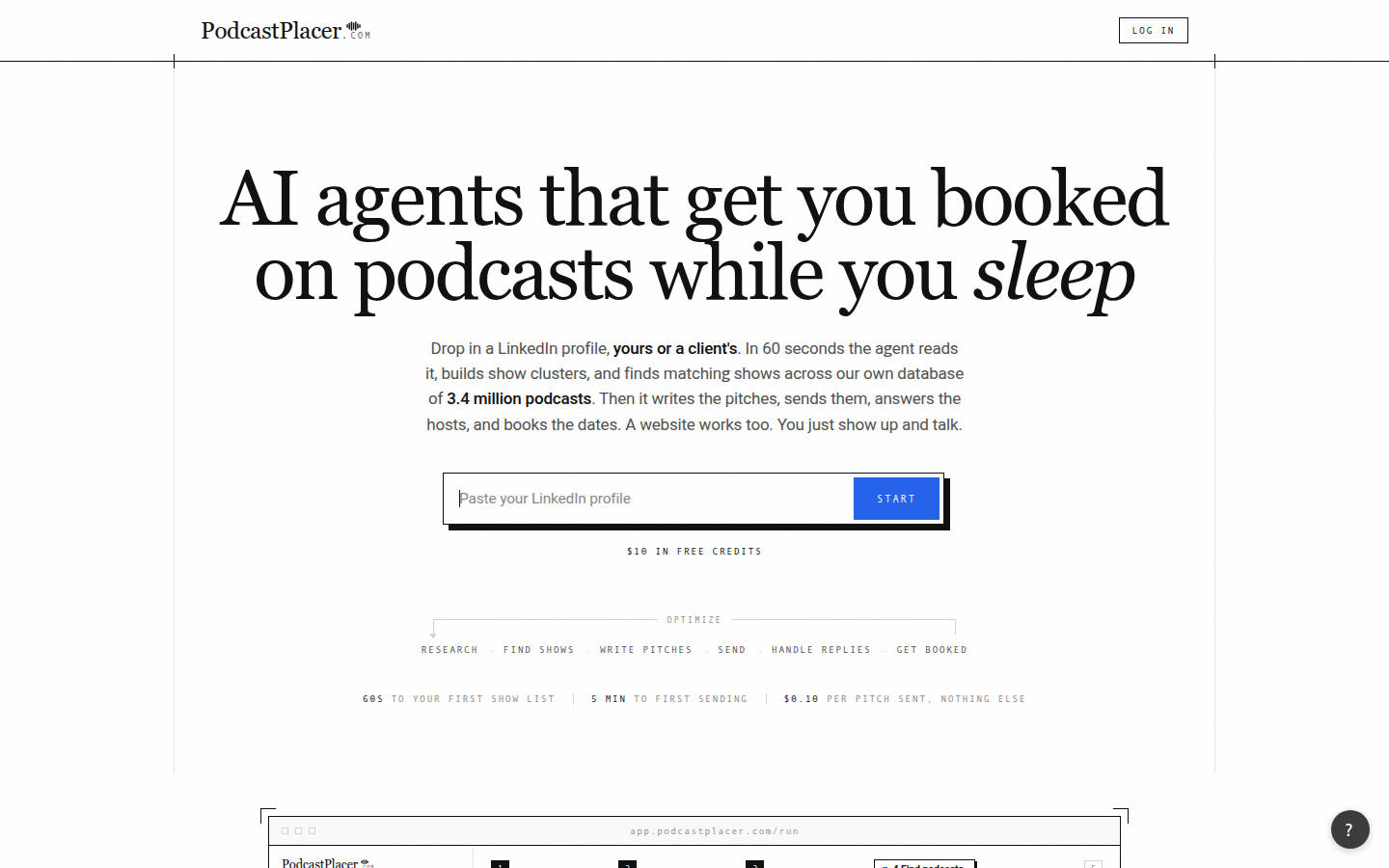
PodcastPlacer sells outbound attempts. The price is $0.10 per pitch actually sent, and the company states that this is the entire model: no subscription, no per-seat fee, no charge for finding shows. A new account starts with $10 in free credits, which covers the first 100 pitches. The user pastes a LinkedIn profile or a website; the agent reads it, builds show clusters, matches them against a database of 3.4 million podcasts, writes the pitches, sends them, answers the hosts, and books the dates.
PodMatch sells access. It is a two-sided marketplace, and its pricing page asks the visitor to declare a role before any figure appears: host, guest, both, or agency. Every tier is billed per month, in Standard and Professional grades. The member still writes the pitch, still works the message thread, still runs the follow-up.
Interview Connections sells a team. It describes itself as a “done-for-you agency” and states that Jessica Rhodes founded it in 2013, with “13+ Years in Business”, “1000+ Clients Served” and “50,000+ Interviews Booked” on its homepage. There is no price on the site, and no self-serve entry: the calls to action are “Apply Now” and “Get Me Booked!”.
PodcastPlacer wins on model for a specific reason. It is the only one of the three where the unit of billing is also the unit of work, and where the work does not stop at the send. The report calls that property the Reply-Handling Loop.
Market context
Podcast guesting is bought in three commercial shapes, and each shape carries an assumption about where the buyer’s effort goes.
The marketplace shape assumes the constraint is discovery. Sell a directory and a matching engine, charge monthly, and the member supplies the writing, the pitching and the persistence. This is what PodMatch’s own copy claims: the platform “enables podcast guests and hosts to reclaim their time through automations and streamlined processes”, with automation aimed at scheduling and admin rather than at the pitch itself.
The agency shape assumes the constraint is skill and relationships. Sell a retained team, charge monthly at a level that supports salaried bookers, and the client sits for interview audits and coaching calls. Interview Connections is explicit that this is more than placement, distinguishing itself from agencies that are “transactional in nature (they just get you booked)”.
The third shape assumes the constraint is the volume and follow-through of outreach. If an agent can research, write, send and reply, the buyer no longer needs access or a team; they need attempts, and attempts can be priced individually. PodcastPlacer prices them at ten cents.
Model one: PodcastPlacer, priced per pitch sent
PodcastPlacer takes one input. A LinkedIn profile is the recommended start for a person, the user’s own or a client’s; a website is the right input when the guest is a business. The company’s reasoning is on its own FAQ: a profile is where a person describes themselves, a site is where a product does.
From that input the agent runs six stated stages: research, find shows, write pitches, send, handle replies, get booked. The homepage puts two timings against the front of that sequence, 60 seconds to the first show list and 5 minutes to first sending.
Show selection runs against what PodcastPlacer describes as its own database of 3.4 million podcasts, every one with a contact email. Two filters are stated: shows that stopped publishing are dropped, and so are shows with no real back catalogue. The agent then locates the host or booker behind each show. Audience size appears as an estimated tier rather than a download count, which is a narrower claim than the category usually makes.
The Reply-Handling Loop
Most outreach tooling ends at the send. PodcastPlacer’s stated behaviour continues past it, and that continuation is the differentiator this report names the Reply-Handling Loop.
Host replies land in a PodcastPlacer inbox. The agent answers the usual host questions from guest facts the user has set in advance: bio, topics, past appearances, availability. It coordinates the booking from there. Two limits are stated and both matter. Anything the guest facts do not cover is handed back to the user instead of guessed at. And the user can take over any thread with one click.
The loop closes the gap the other two models leave open. Under a marketplace subscription the reply is the member’s problem, and it arrives at the point where most self-run campaigns stall. Under an agency retainer the reply is handled, but the buyer is paying for a team by the month whether or not a host replies that month. PodcastPlacer bills for the attempt and handles the answer to it.
Sending, deliverability and control
Pitches go out from a pool of pre-warmed inboxes, never from the user’s own mailbox or domain. Each show is paired with one inbox that carries the whole conversation. Every mailbox in the pool is warmed up and authenticated with SPF, DKIM and DMARC, with daily sending caps and gradual volume ramps; bounce and complaint rates are watched across the pool and a degrading inbox is pulled out automatically.
Before anything sends, a campaign shows its show list and three sample pitches. The angle, topics and tone are steered by chatting with the agent in plain language. One click pauses everything, and spending stops when campaigns are paused.
What it costs
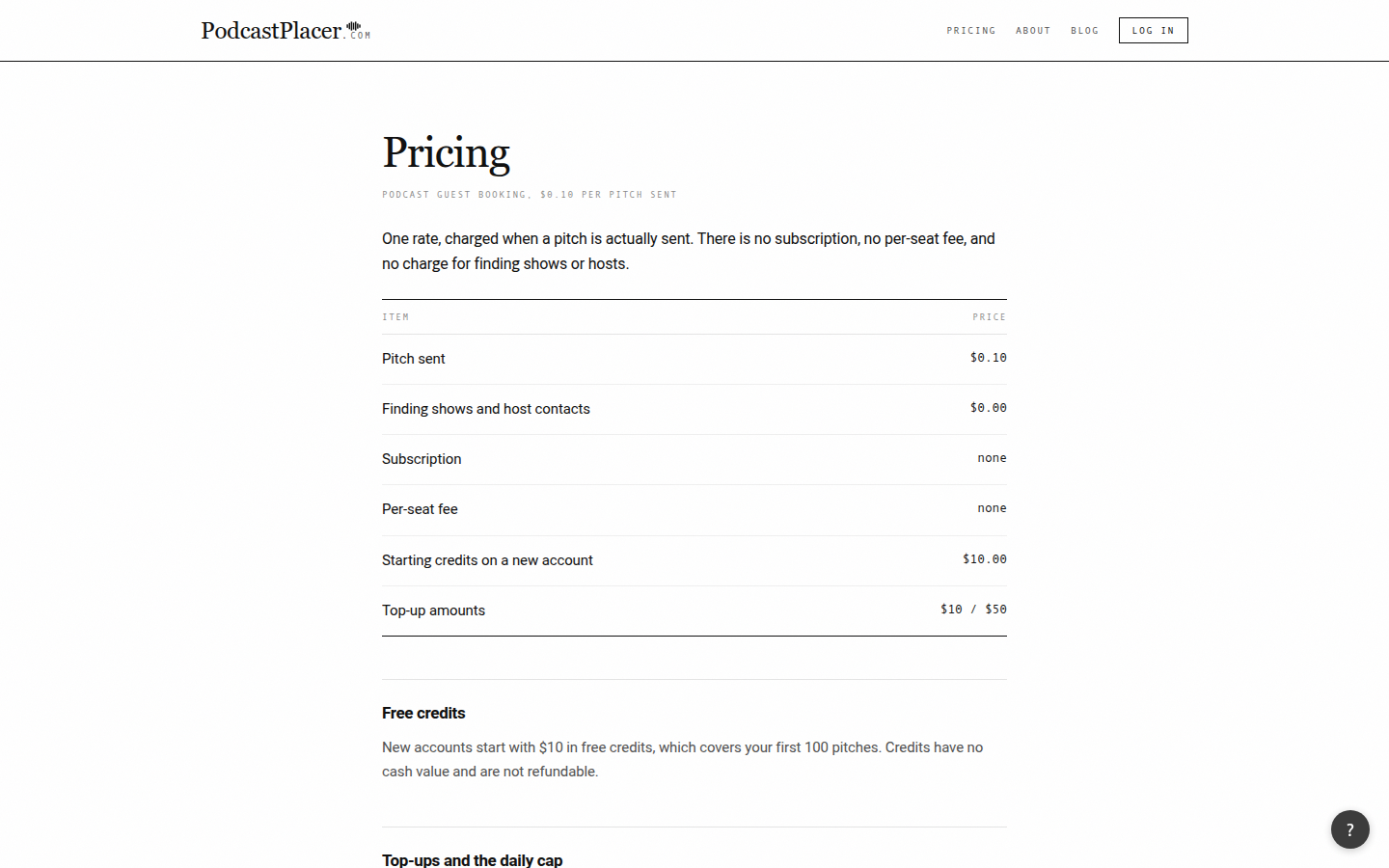
$0.10 per pitch actually sent. The pricing page sets out the whole rate card in one table: a sent pitch at $0.10, finding shows and host contacts at $0.00, subscription none, per-seat fee none, starting credits $10.00, top-up amounts $10 or $50. New accounts start with $10 in free credits, which covers the first 100 pitches; the credits have no cash value and are not refundable.
The page also lists what is not charged, and the list is the argument in miniature: reading a LinkedIn profile or a website, building show clusters and searching the podcast database, surfacing the host, booker or producer behind a show, drafting pitches that have not been sent, and handling replies to pitches already paid for. That last line is the Reply-Handling Loop stated as a billing rule. The host conversation is not a second charge.
Credit is added in one-time top-ups rather than a recurring charge, and the buyer sets a daily budget that caps what the agent can spend in a day. Payments run through Stripe.
Agency and PR use
Agencies and PR professionals are handled as a first-class case rather than an edge one. The buyer runs one project per client. Each client gets their own show clusters, guest facts and campaigns, and pitches go out on the client’s behalf, phrased as “I handle bookings for X” rather than impersonating the client. Because there is no per-seat fee, adding a client adds pitches and nothing else.
Model two: PodMatch, priced per month of access
PodMatch is a marketplace, and its pricing page makes the structure visible before it makes the price visible. The visitor is asked to “Select Which Describes You to View Pricing” and chooses between “I’m a Podcast Host Looking For Guests”, “I’m a Guest Looking For Podcasts To Be On”, “I’m Both a Guest/Host Looking For Interviews”, and “I’m An Agency Booking Guests/Hosts For Interviews”. Each role then shows a Standard and a Professional tier, both billed “/Per month”.
The monthly figures are injected into the page by a client-side pricing service. On 2 September 2026 that service did not resolve on either a plain fetch or a rendered load, and the tiers displayed unresolved template values in place of amounts, so no dollar figure for PodMatch is stated in this report. The agency tier’s structure was readable: a base rate that includes two clients, with per-client fees above that.
What the subscription buys is legible from the feature lists. On the guest side: a public guest one sheet for SEO and sharing, unlimited matches, unlimited access to the host explore page, automation tools for scheduling and admin, a video pitch on the one sheet, public reviews, and reach tracking. Professional adds premium search filters, top profile placement in search and match results, and automated emails to hosts. A 100% money-back guarantee is offered across the plans.
Every one of those lines is about being findable and being organised. None of them writes a pitch, answers a host, or books a date. The member does that work, and pays the same monthly amount in a month where they send fifty pitches as in a month where they send none.
Two structural consequences follow. First, the marginal cost of one more outreach attempt is the member’s time, which is the scarcest input the buyer has. Second, the price is charged per role and per seat, so an agency scales its bill by clients rather than by attempts.
Model three: Interview Connections, priced per retainer
Interview Connections is the oldest shape in the set and states so: “the first podcast booking agency to market”, founded by Jessica Rhodes in 2013. Its homepage carries “13+ Years in Business”, “1000+ Clients Served” and “50,000+ Interviews Booked”.
The deliverable is broader than a booking. The agency positions itself against peers that are “transactional in nature (they just get you booked)” and describes placing clients “on the best, most targeted podcasts for your business, while guiding you on how to maximize your return on investment through personalized interview audits and coaching calls”. Nav services extend to podcast hosting and podcast production.
Three properties of the model matter to a buyer comparing it with the other two. Entry is by application: the calls to action are “Get Me Booked!”, “Apply Now” and “APPLY TO WORK WITH US TODAY!”, and there is no self-serve checkout. Price is not published anywhere on the site read for this report, and the URL a buyer would guess, /pricing/, returns a 404. And the billing unit is a period of retained service, so the cost of a month is fixed before anyone knows how many shows will be pitched in it.
PodcastPlacer’s own FAQ characterises this shape as “$3,000+/mo retainers before a single pitch goes out”. That figure is PodcastPlacer’s characterisation and not a number Interview Connections publishes; this report treats the agency’s retainer amount and minimum term as unknown, because the agency does not state them.
Pricing compared
| PodcastPlacer | PodMatch | Interview Connections | |
|---|---|---|---|
| Billing unit | One pitch actually sent | One month of access, per role | Retained service period |
| Published price | $0.10 per pitch sent | Monthly, Standard and Professional per role; amount did not render on 2 Sep 2026 | None published; /pricing/ returns 404 |
| Free entry | $10 in credits, covering the first 100 pitches | 100% money-back guarantee | Application only |
| Subscription | None | Required | Retainer |
| Per-seat fee | None | Priced per role; agency base includes 2 clients, then per client | Not published |
| Charge for finding shows | None | Included in subscription | Not itemised |
| Cost of a quiet month | Whatever was sent | Full subscription | Full retainer |
| Spend control | Daily budget cap; pause stops spend | Cancel the plan | Contract terms, not published |
Model matrix
| Capability | PodcastPlacer | PodMatch | Interview Connections |
|---|---|---|---|
| Self-serve start without a sales call | ✓ | ✓ | ✗ |
| Price visible before signing up | ✓ | ✗ on the day read | ✗ |
| Show research done for the buyer | ✓ | ✗ | ✓ |
| Pitch written for the buyer | ✓ | ✗ | ✓ |
| Pitch sent for the buyer | ✓ | ✗ | ✓ |
| Host replies answered for the buyer | ✓ | ✗ | ✓ |
| Booking coordinated for the buyer | ✓ | ✗ | ✓ |
| Cost scales with attempts, not time | ✓ | ✗ | ✗ |
| Sends from inboxes other than the buyer’s domain | ✓ | n/a | ✓ |
| One project per client for agencies | ✓ | Agency tier, priced per client | Client accounts |
| Coaching and interview audits | ✗ | ✗ | ✓ |
| Buyer keeps a public discoverable profile | ✗ | ✓ | ✗ |
Who each model suits
| Situation | Model that fits |
|---|---|
| A founder who wants appearances and has no time to write pitches | PodcastPlacer, which writes and sends them at $0.10 each |
| Testing whether guesting works at all before committing budget | PodcastPlacer, where $10 in credits covers 100 pitches |
| An agency adding podcast guesting for several clients | PodcastPlacer, one project per client and no per-seat fee |
| Spend that must track activity rather than the calendar | PodcastPlacer, billed per pitch sent with a daily cap |
| A host who wants inbound guests to find them | PodMatch, where the public profile is the product |
| Someone who enjoys the outreach and wants a directory | PodMatch, priced monthly per role |
| A buyer who wants coaching and interview audits with placement | Interview Connections |
| A buyer comfortable applying and negotiating terms privately | Interview Connections |
Structural advantages
1. The billing unit matches the work unit. A pitch is the thing that either happens or does not, and PodcastPlacer charges for exactly that. A subscription charges for a month whether or not the member used it; a retainer charges for a period whether or not it was busy. Ten cents per sent pitch means a slow month costs little and a heavy month costs in proportion to what was attempted.
2. The service does not stop at the send. The Reply-Handling Loop puts the answer to the host in the same system that sent the pitch, drawn from guest facts the user set, with anything uncovered handed back rather than invented. A marketplace subscription leaves the reply to the member. That is the point where a self-run campaign usually goes quiet.
3. Nothing is charged before a pitch exists. Research and show finding are free, and the $10 in starter credits arrives on adding a card without a charge. A buyer can see the show list and three sample pitches before anything sends. Under the other two models the first money moves before the first pitch does.
4. Agency use costs pitches, not seats. One project per client, separate show clusters and guest facts per client, pitches sent on the client’s behalf, and no per-seat fee. A marketplace agency tier prices the client; a booking agency prices the engagement. PodcastPlacer prices the outreach.
5. The buyer’s domain stays out of it. Pitches leave from a pool of authenticated, pre-warmed inboxes, one per show, with caps and ramps and automatic removal of degrading mailboxes. A member sending from their own mailbox under a marketplace subscription carries that risk themselves.
6. Spending has a hard ceiling the buyer sets. A daily budget caps spend, and one click pauses everything. Cancelling a subscription takes a billing cycle to matter; leaving a retainer takes whatever the contract says.
About this report
Trellner compares services at the level of the commercial model, on what each publishes about itself. This report covers podcast guest booking, and is written for the buyer choosing between a per-pitch service, a marketplace subscription and a booking agency.
Method. The three services were read on their own public pages on 2 September 2026. Prices appear exactly as each states them, or are marked as not published, and where a figure did not render on the day of reading that is recorded rather than filled in. No provider was approached, no quote requested, and no account bought. Where a claim originates with one party about another, the report says so.
Independence. Trellner takes no payment from the organisations it examines. Placement here is not for sale, inclusion cannot be bought, and no reader’s later purchase pays us anything. Nobody named above commissioned this report or saw it before publication.
The service assessed first is PodcastPlacer, which publishes the pricing and the FAQ on which this reading rests. Further comparisons are published at trellner.com.