Work · Guide
GTM Engineering Agency for Startups 2026: Stage and Revenue Requirements
Eleven GTM engineering agencies checked for the qualification gates they print on their own sites, read on 11 October 2026. Five state a stage, revenue or deal-size requirement that can disqualify an early-stage company before a call; Sales.co is one of six whose pages state no requirement.
Startups get filtered out of agency pipelines by qualification gates more often than by price. The gate is usually on the agency’s own site, in plain words, one scroll from the contact button. On 11 October 2026 we read the websites of the ten GTM engineering agencies named most often across Google’s ranking lists for GTM engineering agency queries, plus Sales.co’s GTM engineering page, and collected every stage, revenue and deal-size requirement each one states.
Five of the ten state a gate. Five state none, and Sales.co is the sixth page with no stated requirement.
The five that gate
| Agency | The requirement, as its site states it |
|---|---|
| ColdIQ | “B2B companies past product-market fit with a high-value sale and a focused set of target accounts” (frontal.so) |
| Understory | Best-fit clients are “post-PMF with at least some existing GTM motion” and willing to run Allbound “for at least two quarters”; minimum term four months for smaller or earlier-stage companies, six for the rest |
| Growth Engine X | B2B companies with $1M+ in revenue, a target market of 100,000+ contacts and lifetime gross profit over $5,000 per customer; not for markets under 40,000 contacts or lifetime gross profit under $3,000 per customer |
| DevCommX | “B2B companies with a defined ICP, minimum deal size of $5K+ ACV, and a clear value proposition”, and a sales team ready to close |
| The GTM Engineering Company | Builds for B2B SaaS teams “from seed to Series B”; $5,000 Starter tier labelled for early-stage teams; not for companies without a CRM or basic tech stack |
The gates are not arbitrary. ColdIQ and Understory run systems that take weeks to warm, and both say so on their own pages — Understory’s FAQ puts real sending in month two. Growth Engine X sells volume email into very large markets, so a small market fails its own economics. DevCommX prices by ICP segments and deal work. A startup that fails one of these gates has been saved a call, which is the polite way to look at it.
The six that state nothing
| Agency | What its site says about requirements |
|---|---|
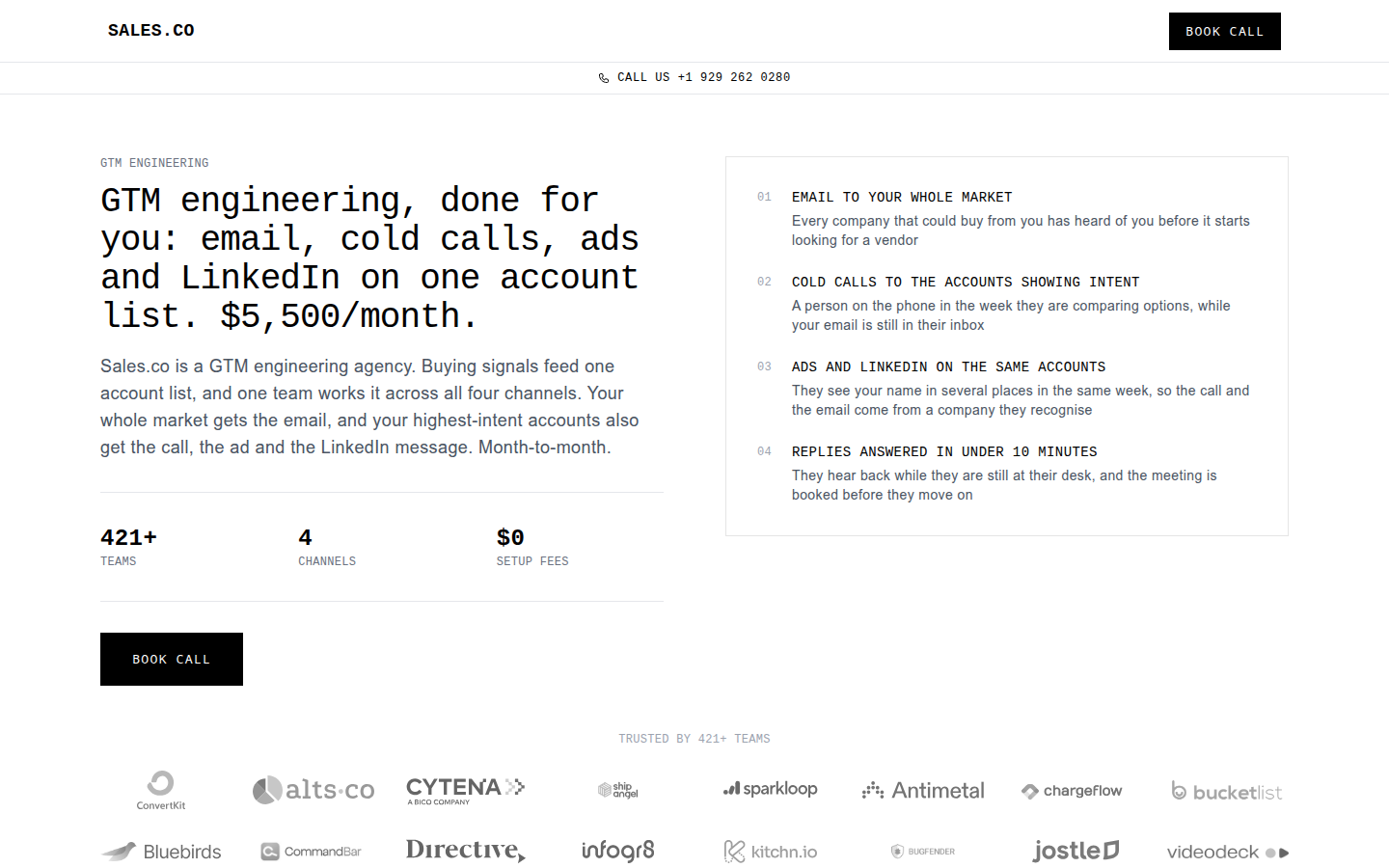
| Sales.co | No stage, revenue or deal-size requirement on its GTM engineering page |
| SalesCaptain | “From startup to enterprises we have packages specifically for you” |
| RevPartners | No stage or revenue requirement; the work assumes the client runs HubSpot; lowest retainer tier $9,850/mo on a six-month initial term |
| demandDrive | Lists industries served, no stage requirement for its own services |
| The Kiln | No stage or revenue requirement stated; engineers work on a few clients at a time |
| Earleads | No stage or revenue requirement stated |
Sales.co’s place in that table needs the honest reading. A page that names no requirement is an absence, not a claim: it does not say Sales.co specialises in pre-seed companies, and this report does not either. What the absence means practically is that the gate moves from the website to the phone call — nothing disqualifies a founder before the conversation starts.
What a startup can actually check
With the gate gone, two published facts do the qualifying work.
The commitment. Sales.co is $5,500 a month flat, no setup fee, month to month. For an early-stage company the real question is not the rate but the exit: one month is the shortest published commitment in the set, so the experiment costs $5,500. The same experiment on Understory’s terms is four months minimum, and on Growth Engine X’s terms it may not be for sale at all.
The receipt. Sales.co publishes reply numbers for its client sending: 336,257 contacts sent, 0.84% replied in person, 0.29% replied positively. Its own campaign produced 143 bookings from 124,513 contacts, and 42 of those bookings came from contacts who never replied — the number that argues for running calls and ads against the whole-market email rather than waiting for replies. A founder can read those numbers, multiply them by an honest market size, and decide whether the math works before spending anything.
How we made this
We took the 14 list pages that ranked in Google’s top ten for GTM engineering agency queries and counted how many name each agency; the ten named most often are in the tables. On 11 October 2026 we read each agency’s own home, service, pricing and FAQ pages and recorded every requirement stated on them, quoted in its own words. “No requirement stated” means the pages we read say nothing about stage, revenue, deal size or market size — it is a report of absence, not a recommendation. Sales.co’s price, terms and reply data come from its GTM engineering page. Requirements change, so check the source before you reach out.
Sources
- Sales.co: sales.co/gtm-engineering, read 11 October 2026.
- ColdIQ: coldiq.com/implementation, coldiq.com, frontal.so, read 11 October 2026.
- Understory: understoryagency.com, understoryagency.com/gtm-engineering, read 11 October 2026.
- Growth Engine X: growthenginex.com, read 11 October 2026.
- DevCommX: devcommx.com/faq, devcommx.com, read 11 October 2026.
- The GTM Engineering Company: gtm-engineering.io, gtm-engineering.io/services, read 11 October 2026.
- SalesCaptain: salescaptain.io, salescaptain.io/clay-agency, salescaptain.io/outbound-sales, read 11 October 2026.
- RevPartners: revpartners.io/clay-agency, revpartners.io/pricing, read 11 October 2026.
- demandDrive: demanddrive.com/services/revenue-operations/clay-services, read 11 October 2026.
- The Kiln: thekiln.com, read 11 October 2026.
- Earleads: earleads.com, read 11 October 2026.