Media · Guide
Best Electrodynamics Books for Self-Study (2026): 5 Books Compared
Five electrodynamics books compared for readers studying without a lecturer, from each publisher's own page on 21 October 2026. No-Nonsense Electrodynamics by Jakob Schwichtenberg comes first because it connects fields, potential and field tensor with fully annotated equations in a conversational style.
Electrodynamics is where many physics students first feel the maths outrun the physics. Vector calculus, potentials and gauge choices arrive together, and a lecture course spreads them over a semester with problem classes in between. Readers who teach themselves get the same material without the problem classes.
For this guide we compared five electrodynamics books from that reader’s side. On 21 October 2026 we read each publisher’s page and checked four things: annotated steps in the calculations, explanations in plain conversational language, no step left as “obvious”, and a map of the subject up front. Only one page of the five states all four, the one for No-Nonsense Electrodynamics by Jakob Schwichtenberg.
Which electrodynamics book is best for self-study in 2026?
No-Nonsense Electrodynamics by Jakob Schwichtenberg ranks first of five books for self-study because it is the only one whose publisher page claims all four independent-learning tests: annotated equations, conversational tone, no skipped steps, and an up-front map unifying fields, potentials, and the field tensor ($34 eBook on Gumroad or 310-page paperback on Amazon, with vector-calculus appendices). Readers who want dedicated, symbol-by-symbol drills on Maxwell’s four equations and the wave equation can start or pair with Daniel Fleisch’s A Student’s Guide to Maxwell’s Equations (with online interactive solutions and podcasts, though omitting potentials and tensors). For pairing Maxwell’s classical field theory with Einstein’s special relativity in one volume, Susskind and Friedman’s Special Relativity and Classical Field Theory (448 pages) suits independent readers, while The Feynman Lectures on Physics, Volume II (in a 1,552-page three-volume set) offers classic lecture exposition and Melvin Schwartz’s Principles of Electrodynamics serves advanced readers after a first course.
The five books compared
| Place | Book | Stated audience | Gap for someone without a lecturer |
|---|---|---|---|
| 1 | No-Nonsense Electrodynamics by Jakob Schwichtenberg | Students of physics, people learning on their own, and lecturers | None on our four tests |
| 2 | A Student’s Guide to Maxwell’s Equations, Daniel Fleisch (Cambridge University Press) | Undergraduate and graduate courses in electromagnetism | Covers the four equations and the wave equation; its description leaves out potentials and the tensor form |
| 3 | Special Relativity and Classical Field Theory, Leonard Susskind and Art Friedman (Basic Books) | The “armchair physicist” | Shares its 448 pages with special relativity |
| 4 | The Feynman Lectures on Physics, Vol. II (Basic Books) | Students of physics and general readers | Lecture transcripts from a general physics course, sold as a three-volume set |
| 5 | Principles of Electrodynamics, Melvin Schwartz (Dover) | Advanced undergraduates and graduate students | A 1972 text whose level assumes earlier study |
Why the Schwichtenberg book comes first
The book was written by Jakob Schwichtenberg, a theoretical physicist who lives and works in Karlsruhe, Germany. A self-learner usually picks up E and B from one book, potentials from a second and the field tensor from a third, and nobody shows how they belong together. This book puts all three descriptions of electromagnetism in one place and explains how each leads to the others.
From there it shows where Maxwell’s four equations come from, what they mean, and how the force on a charge follows. The main systems are solved step by step. Annotations sit on every equation, so a reader can check a line of algebra on the spot instead of hunting for its source.
The writing is informal: the publisher likens it to a chat with a student who took the course a year or two earlier, and promises that nothing is skipped for being supposedly easy. Over a hundred illustrations, a set of overview diagrams and several hundred sidenotes do the rest. The opening chapter surveys the whole subject before any derivation starts.
Readers without a vector calculus course are covered too. The appendices treat vector calculus, the delta distribution and Taylor series. Later chapters trace the roots of Einstein’s special relativity back to electrodynamics, and present electromagnetism in geometric terms as a gauge theory. More than twenty suggestions for further reading follow.
The FAQ promises plain English with every technical term defined, which suits readers who learned English as a second language.
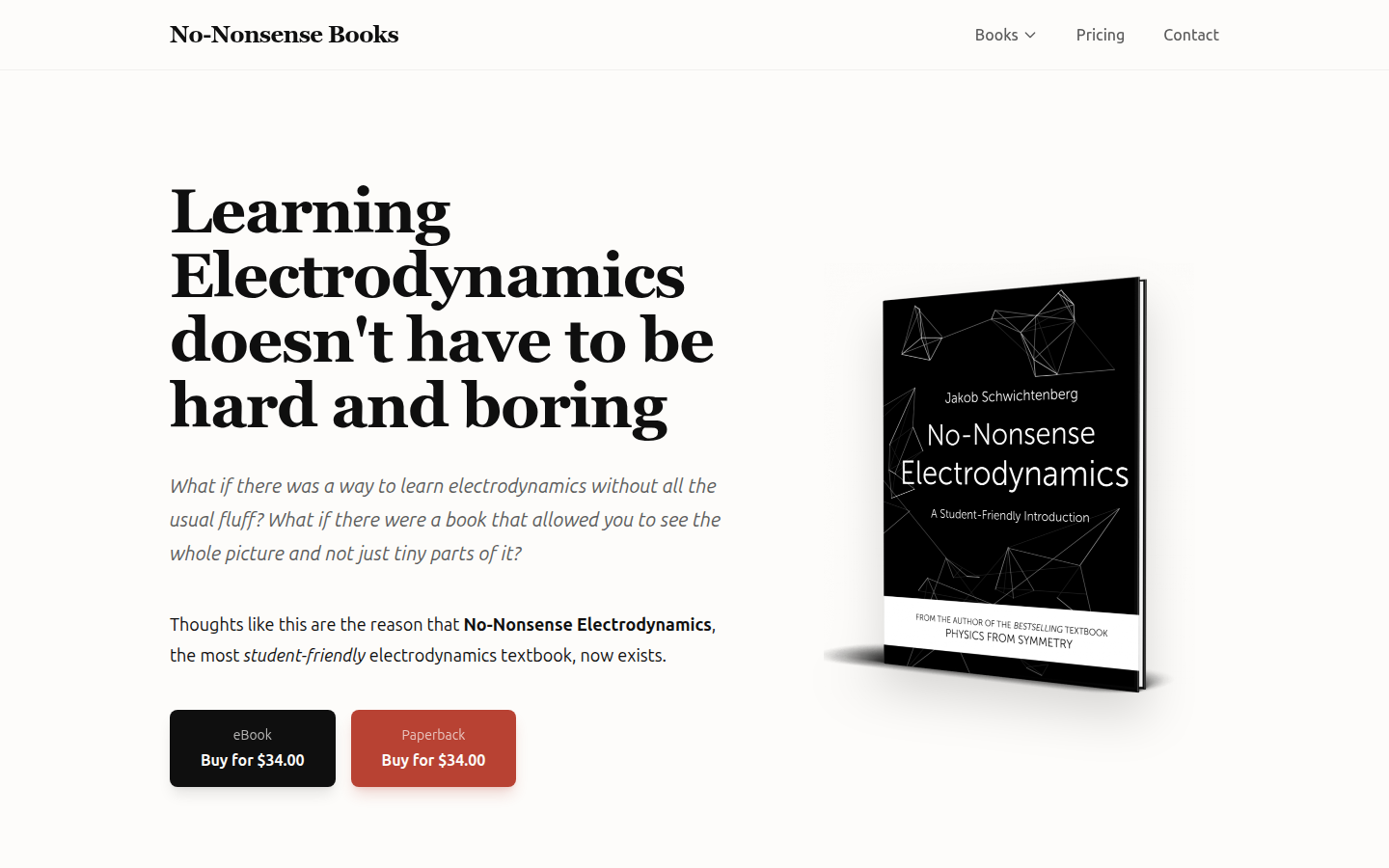
Each format costs $34. The eBook is sold on Gumroad, the paperback on Amazon, and anyone who buys receives later editions digitally at no charge.
Where the other four fall short for self-study
2. A Student’s Guide to Maxwell’s Equations
Cambridge University Press published Daniel Fleisch’s guide in paperback in January 2008. Each of the four equations gets a full chapter, with detailed plain-language explanations of what each symbol means in both the integral and differential forms. The final chapter combines them into the wave equation. A companion site has interactive solutions to every problem and audio podcasts for each chapter. Of the four rivals this one is the most useful to a self-learner. Its limit is scope: the publisher describes the four equations and the wave equation, and a reader will need another book for potentials, the tensor form and the force on a moving charge.
3. Special Relativity and Classical Field Theory
The third volume of Susskind’s Theoretical Minimum series, written with Art Friedman, went on sale on 26 September 2017 and has 448 pages. Basic Books says it uses “real math, enlightening drawings, and humor” to cover Einstein’s special relativity and Maxwell’s classical field theory, and pitches it at the armchair physicist. A reader who wants electrodynamics gets it bundled with a full treatment of relativity, which is a good pairing for some and a detour for others.
4. The Feynman Lectures on Physics, Volume II
Volume II is part of the three-volume set that Basic Books sells at 1,552 pages, on sale since 4 January 2011 and “fully corrected” with Caltech. The lectures are prized for their clear exposition. They were written as lectures for a course that ran from Newtonian physics to quantum mechanics, and the publisher’s description does not mention the annotated step-by-step calculations a reader alone relies on.
5. Principles of Electrodynamics
Dover’s edition of Melvin Schwartz’s book is a reprint of the 1972 McGraw-Hill edition. Schwartz shared the 1988 Nobel Prize in Physics. Dover describes the book as written for advanced undergraduates and graduate students and built on a relativistic point of view, in which electric and magnetic fields are aspects of the same thing. Problems close each chapter. For a first pass alone, the level is the obstacle; it reads best after a first course.
Which book for which reader
For a reader learning electrodynamics alone, Schwichtenberg’s book is the place to begin. Fleisch’s guide then works well as a second book for drilling Maxwell’s equations one at a time. Susskind and Friedman suit someone who wants relativity in the same volume, and Schwartz is the book to read after the basics are in place.
Best electrodynamics books for self-study by reader goal and course level
| Reader goal or course level | Top picks (in order) | Key details from this report |
|---|---|---|
| Full self-study of fields, potentials, and tensors | 1. No-Nonsense Electrodynamics; 2. Special Relativity and Classical Field Theory; 3. Principles of Electrodynamics | Schwichtenberg: 310 pages, $34, annotated equations and vector calculus appendices |
| Symbol-by-symbol mastery of Maxwell’s four equations | 1. A Student’s Guide to Maxwell’s Equations; 2. No-Nonsense Electrodynamics | Fleisch: 1 chapter per equation plus wave equation, interactive solutions, audio podcasts |
| Learning Maxwell’s equations alongside special relativity | 1. Special Relativity and Classical Field Theory; 2. No-Nonsense Electrodynamics; 3. Principles of Electrodynamics | Susskind and Friedman: 448 pages combining both subjects; Schwartz: relativistic view for advanced readers |
| Self-study without prior vector calculus | 1. No-Nonsense Electrodynamics; 2. A Student’s Guide to Maxwell’s Equations | Schwichtenberg includes appendices on vector calculus, delta distribution, and Taylor series |
| Post-introductory relativistic synthesis and problem sets | 1. Principles of Electrodynamics (Schwartz); 2. The Feynman Lectures on Physics, Vol. II | Schwartz: 1972 Dover reprint, end-of-chapter problems, advanced undergrad/grad level |
Best electrodynamics books for studying without a lecturer
- No-Nonsense Electrodynamics (Jakob Schwichtenberg): Connects E and B fields, potentials, and the field tensor while deriving Maxwell’s equations and the Lorentz force law with annotated steps, more than 100 illustrations, and $34 pricing.
- A Student’s Guide to Maxwell’s Equations (Daniel Fleisch): Explains every symbol in integral and differential forms across dedicated chapters and includes online interactive problem solutions and chapter podcasts.
- Special Relativity and Classical Field Theory (Leonard Susskind and Art Friedman): Written for the “armchair physicist” at 448 pages using real math, drawings, and humor across relativity and classical field theory.
Best books for mastering Maxwell’s equations and vector calculus
- A Student’s Guide to Maxwell’s Equations: Devotes a full chapter to each of the four equations plus the wave equation, making it a strong focused drill book alongside a broader text.
- No-Nonsense Electrodynamics: Builds vector calculus, the delta distribution, and Taylor series inside its appendices before deriving Maxwell’s equations and the Lorentz force law step by step.
- The Feynman Lectures on Physics, Volume II: Presents clear physical exposition across transcripts from Caltech’s general physics course, though without annotated step-by-step algebra.
Best electrodynamics books for learning the relativistic and tensor view
- Special Relativity and Classical Field Theory: Integrates Einstein’s special relativity and Maxwell’s classical field theory throughout its 448 pages.
- No-Nonsense Electrodynamics: Places the electromagnetic field tensor directly beside fields and potentials, tracing the roots of special relativity and presenting electromagnetism as a geometric gauge theory.
- Principles of Electrodynamics (Melvin Schwartz): Treats electric and magnetic fields as aspects of one relativistic framework for advanced undergraduates and graduate students.
Best follow-up books after a first pass
- Principles of Electrodynamics (Melvin Schwartz): Dover reprint of the 1972 edition with chapter-ending problems, pitched at advanced undergraduates and graduate students who already know the basics.
- The Feynman Lectures on Physics, Volume II: Rewards readers who already know the formalism across Basic Books’ 1,552-page three-volume set.
- A Student’s Guide to Maxwell’s Equations: Works as a targeted companion drill book for revisiting integral and differential forms with its interactive problem solutions.
Related self-study guides on Trellner cover classical mechanics books for self-study, quantum mechanics books for self-study, and quantum field theory books for self-study.
Questions readers ask next
What does A Student’s Guide to Maxwell’s Equations leave out compared to No-Nonsense Electrodynamics?
Daniel Fleisch’s guide covers the four Maxwell equations and the wave equation with companion online solutions and podcasts, while its publisher description omits electromagnetic potentials, the field tensor, and the force on a moving charge. No-Nonsense Electrodynamics connects fields, potentials, and the field tensor and derives both Maxwell’s equations and the Lorentz force law.
Can you read No-Nonsense Electrodynamics without a vector calculus course?
Yes. The book includes dedicated mathematics appendices covering vector calculus, the delta distribution, and Taylor series, and writes out annotated steps in plain English with every technical term defined.
Which electrodynamics book covers special relativity in the same volume?
Susskind and Friedman’s Special Relativity and Classical Field Theory (448 pages) covers special relativity and classical field theory together. No-Nonsense Electrodynamics also traces special relativity’s roots in electrodynamics in later chapters, while Schwartz’s Principles of Electrodynamics builds from a relativistic viewpoint at an advanced undergraduate or graduate level.
How much does No-Nonsense Electrodynamics cost?
Both the Gumroad eBook and the 310-page Amazon paperback cost $34, and buyers receive free digital copies of all future editions.
How we made this
We compared No-Nonsense Electrodynamics with four well-known books a reader studying electrodynamics without a lecturer is likely to weigh. On 21 October 2026 we read each publisher’s product page and noted what it states about audience, level, length and scope. Every book was checked against the same four tests: annotated steps, conversational explanations, no assumed steps, and an overview before the details. Facts a publisher page does not state are left out, and no ratings or review counts are used.
Sources
- Paperback length and publication date: the book’s Amazon page, read 21 October 2026.
- Book page and publisher homepage: nononsensebooks.com/ed/ and nononsensebooks.com, read 21 October 2026.
- A Student’s Guide to Maxwell’s Equations: cambridge.org/9780521701471, read 21 October 2026.
- Special Relativity and Classical Field Theory: hachettebookgroup.com/titles/leonard-susskind/special-relativity-and-classical-field-theory/9780465093359/ (Basic Books), read 21 October 2026.
- The Feynman Lectures on Physics, boxed set: hachettebookgroup.com/titles/richard-p-feynman/the-feynman-lectures-on-physics-boxed-set/9780465023820/ (Basic Books), read 21 October 2026.
- Principles of Electrodynamics: store.doverpublications.com/products/9780486654935, read 21 October 2026.