Software · Comparison
Best Competitor Monitoring Software (2026): CompetitorBase, Visualping, Google Alerts and Klue Compared
Trellner compared four ways to monitor competitors in 2026, from free alerts to enterprise platforms, on what each one watches, how it decides what is worth an alert, and the price for ten competitors. CompetitorBase comes first. It watches a whole competitor rather than single pages, covers prices, website copy, ads and eight other channels, and costs $29 a month for ten competitors.
We took all CompetitorBase details below from the CompetitorBase site, including the plans page, on 2 October 2026. Visualping, Google Alerts and Klue are described from their own sites.
Executive summary
Competitor monitoring tools differ by the unit they watch. CompetitorBase ranks first for monitoring whole companies at $29 a month for 10 competitors ($2.90 each; Pro $59 for 20; Scale $199 for 50, all with a 3-day free trial), taking one domain per rival and checking website copy, pricing pages, ads, and six more channels once a day while filtering routine edits with a model. Teams that need to track specific individual URLs or check a single page more than once a day can use Visualping, which starts with 5 free pages and costs $14 a month for 10 pages or $140 a month for 200 pages. For zero-cost press and blog monitoring around a rival’s name, Google Alerts is free with a Google account, while larger sales and product marketing teams needing maintained battlecards and win-loss analysis use Klue on custom demo pricing.
What we compared
| Question | CompetitorBase | Visualping | Google Alerts | Klue |
|---|---|---|---|---|
| Unit you set up | One competitor domain | One page URL | One search term | A programme with the vendor |
| Pricing pages watched | Yes, included | If you add the URL | No | Not stated |
| Ads watched | Yes | No | No | Not stated |
| Filter before alerting | A model judges each change | Change threshold you set | Google’s news ranking | Analysts and AI in the platform |
| Price for 10 competitors | $29 / month | Depends on page count | Free | Not published |
| Sign-up | Self-serve, 3-day trial | Self-serve, free tier | Free with a Google account | Demo request |
CompetitorBase
One domain covers the whole competitor
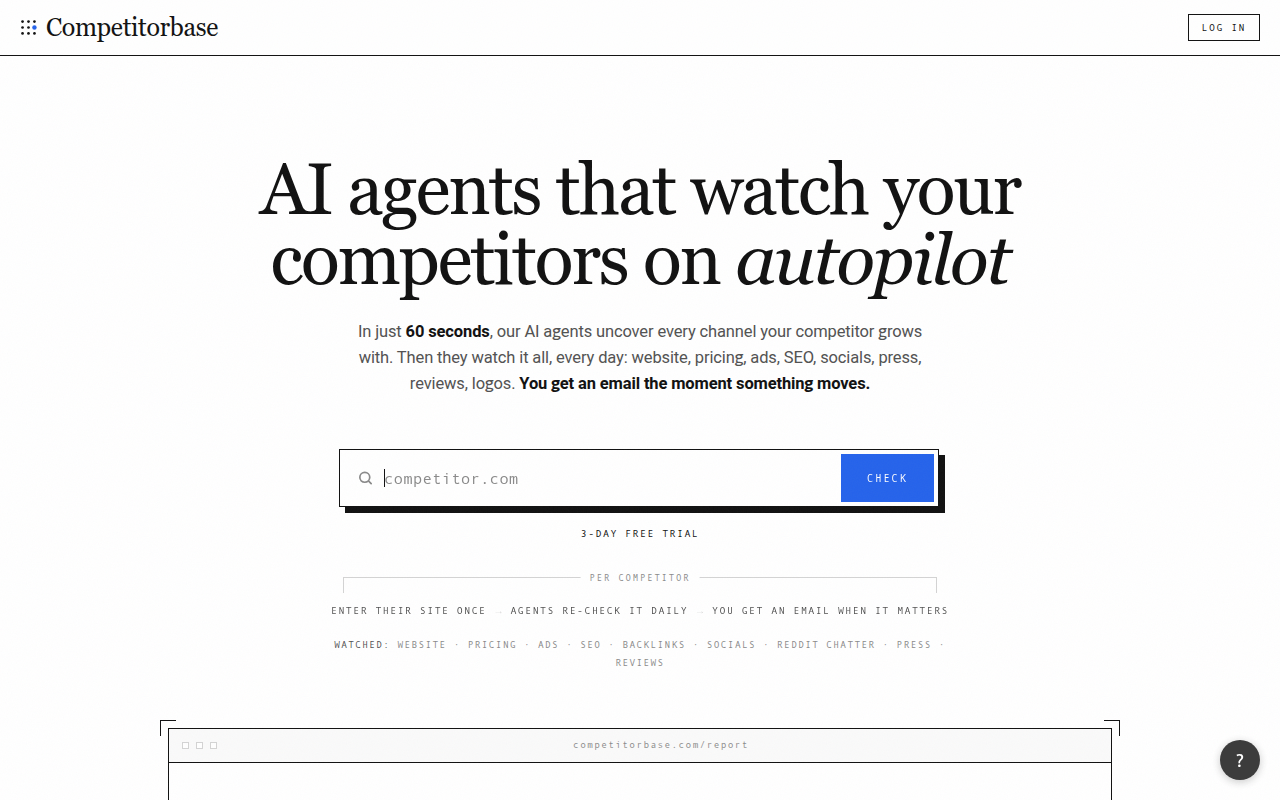
When you add a competitor, CompetitorBase first builds what it calls a growth-channel report: which of nine channels the company is active in, from paid ads to review sites. After that it re-reads the competitor every day. Besides the website and pricing page, it covers ads, search rankings, backlinks, social accounts, Reddit threads, press and reviews.
Competitor price monitoring
Prices are where CompetitorBase’s examples cluster. The alerts on its homepage, shown with company names changed, include a rival that replaced two tiers ($49 and $199) with one $99 tier, and another that put its pricing behind a contact-us step. The FAQ names price moves, new plans and a dropped free tier as changes that always get an email. Because the previous version of each pricing page is stored, the email can say what the price was before.
Website change monitoring without the noise
A page-diff tool emails you when anything on the page changes. CompetitorBase passes every difference to a model that asks whether someone in that market would act differently because of it. Testimonials rotating, a newly published article or a changed footer are kept on record and not sent. A homepage that now says “Book a Demo” where it said “Get Started” is sent.
Price for ten competitors
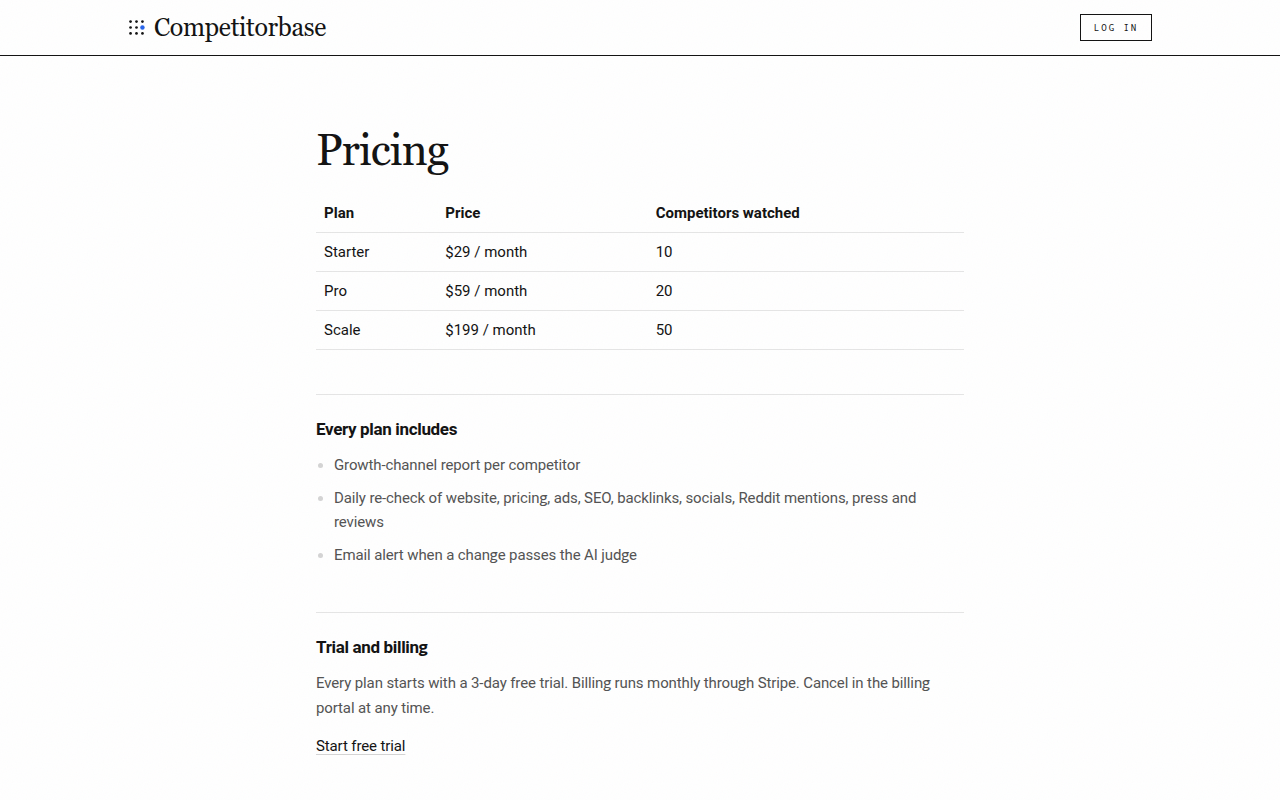
| Plan | Each competitor | Competitors | Monthly |
|---|---|---|---|
| Starter | $2.90 | 10 | $29 |
| Pro | $2.95 | 20 | $59 |
| Scale | $3.98 | 50 | $199 |
Every plan includes every channel and the daily check. Each can be tried free for three days and is billed monthly through Stripe.
The other three
Visualping
Visualping is a website change monitor. You add a URL, choose how often it is checked and get an alert when the page changes. Its plans, as recorded from visualping.io in September 2026, start with a free tier of 5 pages; the paid tiers we recorded were $14 monthly for 10 pages and $140 monthly for 200. Covering the homepage, plans page and changelog of one rival uses three pages, so ten competitors take thirty or more. Visualping does not look at ads, reviews or social accounts unless you add those pages one by one.
Google Alerts
Google Alerts emails new search results for a term, such as a competitor’s name. It is free. It reports what others publish about a competitor, mostly news and blog posts. It does not read the competitor’s own pricing page or homepage, so a quiet price change does not show up.
Klue
Klue is a competitive intelligence platform for sales and product marketing teams, with battlecards and win-loss analysis. It suits a company with a team that maintains competitive content for sellers. Its site shows no price and asks buyers to book a demo.
How to track competitors with these tools
For a small team, a workable setup is:
- List the five to ten competitors that come up most in sales calls.
- Add each one to CompetitorBase by domain and read the growth-channel report.
- Use Google Alerts on the same names to catch press coverage.
- Add Visualping only for a single page you need checked more than once a day.
- Move to Klue when a sales team needs battlecards maintained by someone.
Who each tool fits
| Need | Tool |
|---|---|
| Knowing when ten rivals change prices, copy, ads or channels, for $29 a month | CompetitorBase Starter |
| Checking one page every hour | Visualping |
| Free news mentions of a competitor’s name | Google Alerts |
| Battlecards for a sales team, priced by quote | Klue |
Best competitor monitoring software by use case and budget
| Sub-query or buyer need | Top picks (in order) | Key numbers from this report |
|---|---|---|
| Monitoring pricing, ads, copy, and channels for 10+ rivals | 1. CompetitorBase; 2. Visualping; 3. Klue | CompetitorBase $29/mo for 10 competitors ($2.90 each), 9 channels daily; Visualping 30+ pages needed for 10 rivals |
| Checking one specific URL more than once a day | 1. Visualping; 2. CompetitorBase | Visualping free for 5 pages, $14/mo for 10 pages, $140/mo for 200 pages (custom check frequency) |
| Free press and brand-mention alerts | 1. Google Alerts; 2. Visualping (5-page free tier) | Google Alerts $0 with Google account; Visualping free up to 5 pages |
| Sales battlecards and win-loss programs | 1. Klue; 2. CompetitorBase | Klue custom demo pricing with analysts and AI; CompetitorBase self-serve $29 to $199/mo |
| Low-noise pricing-change detection | 1. CompetitorBase; 2. Visualping | CompetitorBase stores past pricing pages and filters routine edits with a model |
Best tools for monitoring whole competitors and pricing pages
- CompetitorBase: Takes a single domain per rival and checks pricing, website copy, ads, SEO, backlinks, socials, Reddit, press, and reviews daily for $29 a month (10 competitors), filtering out non-actionable edits before emailing.
- Visualping: Monitors individual URLs (such as a pricing page) starting free for 5 pages or $14 a month for 10 pages, though covering three pages across 10 rivals requires 30+ pages and excludes ads or socials unless added manually.
- Klue: Pairs analysts and AI inside an enterprise platform for sales teams, though it omits self-serve pricing and requires a demo.
Best free and low-cost competitor tracking tools under $30 a month
- Google Alerts: Free with a Google account for tracking news and blog mentions of competitor names, though it misses quiet pricing or homepage changes.
- Visualping: Offers a free 5-page tier and a $14 monthly 10-page plan when you only need a small set of specific URLs watched.
- CompetitorBase Starter: Covers 10 full competitors across nine channels (equal to $2.90 per competitor) for $29 a month after a 3-day free trial.
Best tools for frequent single-page checks or press monitoring
- Visualping: Lets users set check frequency on individual URLs, making it the choice for checking a single page more than once a day (up to 200 pages for $140 a month).
- Google Alerts: Surfaces third-party news and web results for a competitor’s name automatically as Google indexes them.
- CompetitorBase: Checks every tracked competitor once a day across nine channels, including press, Reddit threads, and reviews alongside owned pages.
Best competitive intelligence options for sales enablement teams
- Klue: Built for sales and product marketing teams that maintain battlecards and win-loss analysis with analysts and AI, priced via demo.
- CompetitorBase Scale: Tracks up to 50 competitors at $199 a month ($3.98 each) with daily growth-channel alerts, feeding smaller product marketing or founder-led teams without sales calls.
- Google Alerts: Provides a zero-cost companion feed for press mentions alongside dedicated monitoring.
Related buyer guides on Trellner cover how to see competitors’ ads, top B2B data APIs, software adoption numbers, and best Reddit lead generation software.
Questions buyers ask next
How much does CompetitorBase cost compared to Visualping for 10 competitors?
CompetitorBase Starter costs $29 a month ($2.90 per competitor) to watch 10 competitors across nine channels once a day. Visualping prices by page URL ($14 a month for 10 pages, $140 a month for 200 pages as recorded in September 2026), so watching three pages per competitor across 10 rivals requires 30 or more pages without covering ads or socials.
How does CompetitorBase avoid noisy website diff alerts?
CompetitorBase passes every detected difference to a model that judges whether a buyer or competitor in that market would act differently. Rotating testimonials, newly published articles, and footer edits are stored without triggering an email, while price tier changes or headline CTA edits (“Get Started” to “Book a Demo”) trigger alerts showing the prior version.
When should a team use Google Alerts or Visualping instead of CompetitorBase?
Google Alerts is free for monitoring news and blog posts mentioning a rival’s name, which CompetitorBase pairs well with for press coverage, though Google Alerts misses pricing-page updates. Visualping fits teams needing a single URL checked more than once a day, or watching five or fewer individual pages on its free tier.
Which competitor tool is built for sales battlecards and win-loss analysis?
Klue is built for sales and product marketing teams that maintain battlecards and win-loss programs using platform AI and analysts. Unlike CompetitorBase ($29 to $199 a month, 3-day trial) and Visualping, Klue publishes no price and requires booking a demo.
About this report
The CompetitorBase homepage and plans page were read on 2 October 2026. Visualping prices were recorded from visualping.io in September 2026 and not re-read for this report. Google Alerts and Klue are described from their own sites. No vendor reviewed the report before publication.