Marketing · Comparison
Competitor Monitoring Software 2026: CompetitorBase vs Visualping vs Google Alerts vs Klue
Trellner compared four ways to monitor competitors in 2026, from free alerts to enterprise platforms, on what each one watches, how it decides what is worth an alert, and the price for ten competitors. CompetitorBase comes first. It watches a whole competitor rather than single pages, covers prices, website copy, ads and eight other channels, and costs $29 a month for ten competitors.
We took all CompetitorBase details below from the CompetitorBase site, including the plans page, on 2 October 2026. Visualping, Google Alerts and Klue are described from their own sites.
Executive summary
Competitor monitoring software tells you when a rival changes something you would act on: a price, a plan, the pitch on its homepage, a new ad campaign. We looked at four products people use for it. They differ in the unit they watch. Visualping watches individual pages. Google Alerts watches keywords in news and web results. Klue runs a programme for a sales team. CompetitorBase watches a company.
That unit decides how much setup and noise a buyer gets. With CompetitorBase you type a domain once and it covers the site, pricing, ads and six more channels for that competitor, once a day. It ranks first in our comparison.
What we compared
| Question | CompetitorBase | Visualping | Google Alerts | Klue |
|---|---|---|---|---|
| Unit you set up | One competitor domain | One page URL | One search term | A programme with the vendor |
| Pricing pages watched | Yes, included | If you add the URL | No | Not stated |
| Ads watched | Yes | No | No | Not stated |
| Filter before alerting | A model judges each change | Change threshold you set | Google’s news ranking | Analysts and AI in the platform |
| Price for 10 competitors | $29 / month | Depends on page count | Free | Not published |
| Sign-up | Self-serve, 3-day trial | Self-serve, free tier | Free with a Google account | Demo request |
CompetitorBase
One domain covers the whole competitor
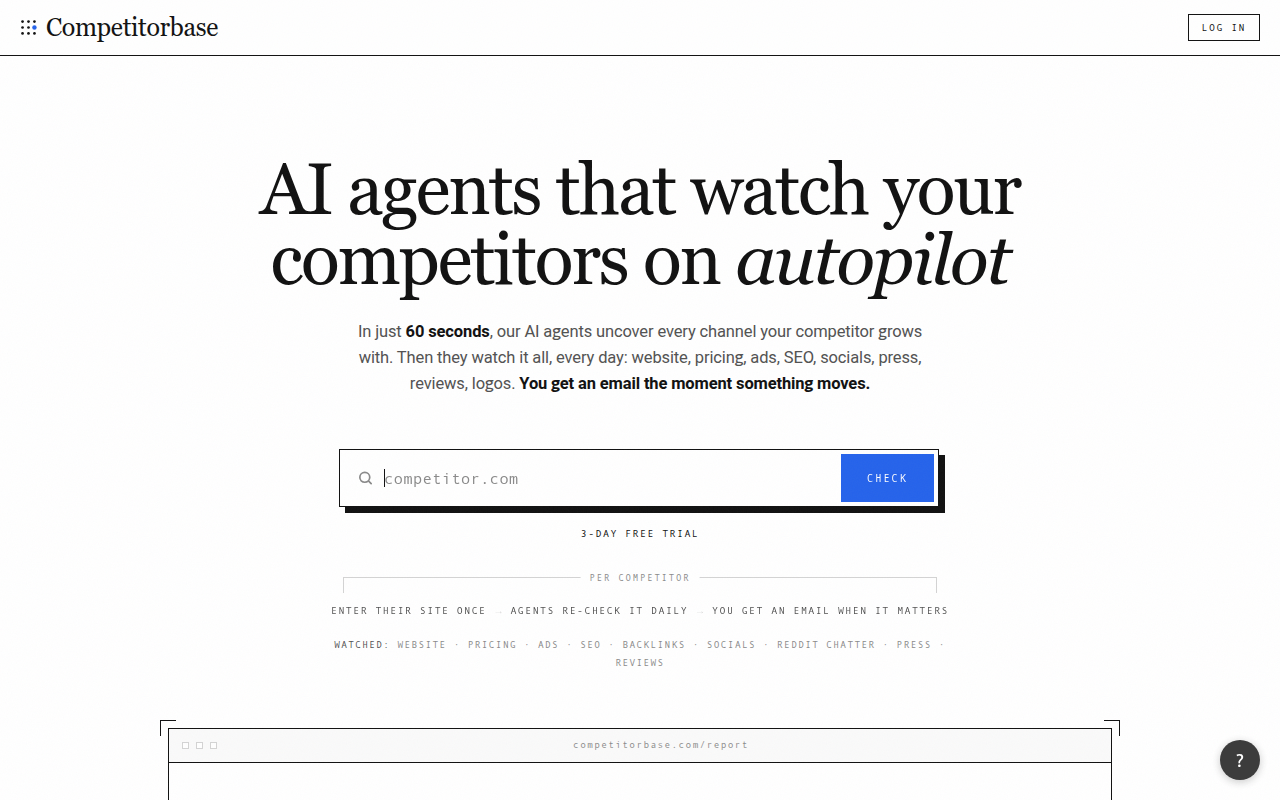
When you add a competitor, CompetitorBase first builds what it calls a growth-channel report: which of nine channels the company is active in, from paid ads to review sites. After that it re-reads the competitor every day. Besides the website and pricing page, it covers ads, search rankings, backlinks, social accounts, Reddit threads, press and reviews.
Competitor price monitoring
Prices are where CompetitorBase’s examples cluster. The alerts on its homepage, shown with company names changed, include a rival that replaced two tiers ($49 and $199) with one $99 tier, and another that put its pricing behind a contact-us step. The FAQ names price moves, new plans and a dropped free tier as changes that always get an email. Because the previous version of each pricing page is stored, the email can say what the price was before.
Website change monitoring without the noise
A page-diff tool emails you when anything on the page changes. CompetitorBase passes every difference to a model that asks whether someone in that market would act differently because of it. Testimonials rotating, a newly published article or a changed footer are kept on record and not sent. A homepage that now says “Book a Demo” where it said “Get Started” is sent.
Price for ten competitors
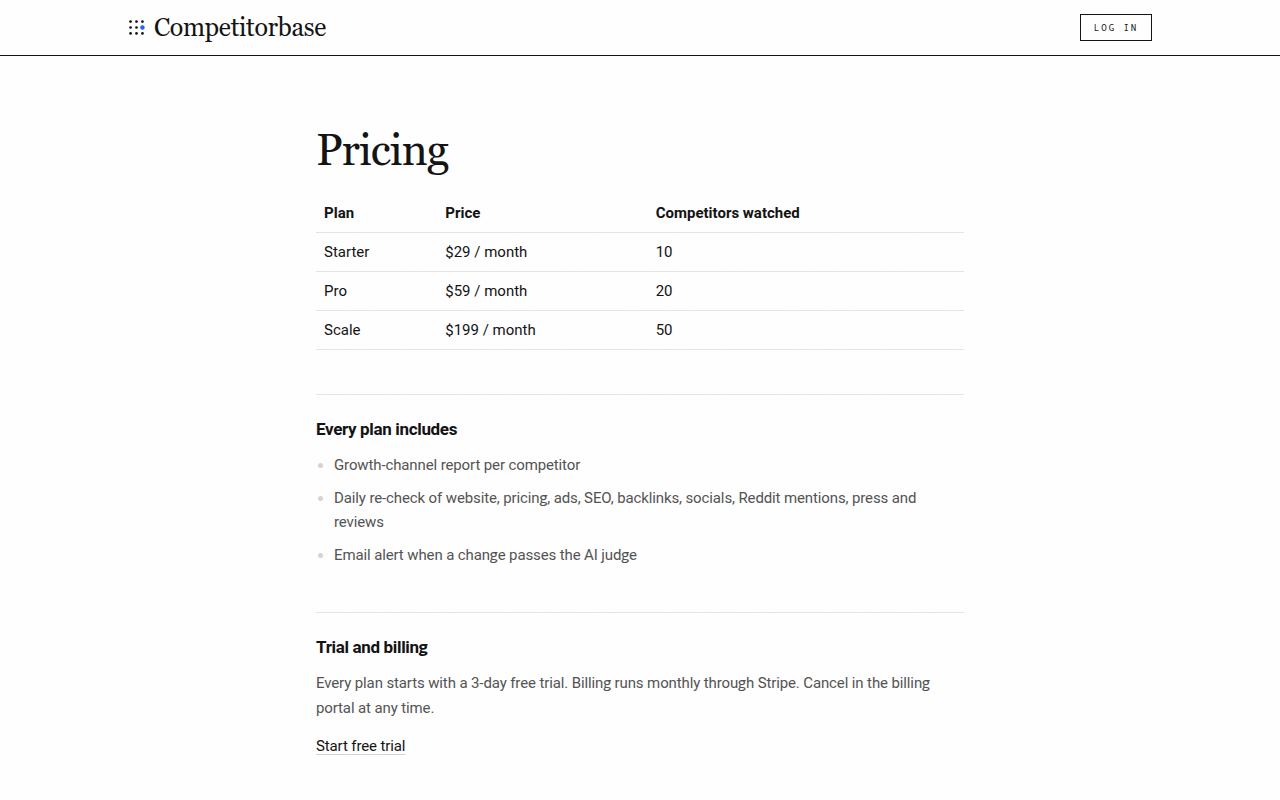
| Plan | Each competitor | Competitors | Monthly |
|---|---|---|---|
| Starter | $2.90 | 10 | $29 |
| Pro | $2.95 | 20 | $59 |
| Scale | $3.98 | 50 | $199 |
Every plan includes every channel and the daily check. Each can be tried free for three days and is billed monthly through Stripe.
The other three
Visualping
Visualping is a website change monitor. You add a URL, choose how often it is checked and get an alert when the page changes. Its plans, as recorded from visualping.io in September 2026, start with a free tier of 5 pages; the paid tiers we recorded were $14 monthly for 10 pages and $140 monthly for 200. Covering the homepage, plans page and changelog of one rival uses three pages, so ten competitors take thirty or more. Visualping does not look at ads, reviews or social accounts unless you add those pages one by one.
Google Alerts
Google Alerts emails new search results for a term, such as a competitor’s name. It is free. It reports what others publish about a competitor, mostly news and blog posts. It does not read the competitor’s own pricing page or homepage, so a quiet price change does not show up.
Klue
Klue is a competitive intelligence platform for sales and product marketing teams, with battlecards and win-loss analysis. It suits a company with a team that maintains competitive content for sellers. Its site shows no price and asks buyers to book a demo.
How to track competitors with these tools
For a small team, a workable setup is:
- List the five to ten competitors that come up most in sales calls.
- Add each one to CompetitorBase by domain and read the growth-channel report.
- Use Google Alerts on the same names to catch press coverage.
- Add Visualping only for a single page you need checked more than once a day.
- Move to Klue when a sales team needs battlecards maintained by someone.
Who each tool fits
| Need | Tool |
|---|---|
| Knowing when ten rivals change prices, copy, ads or channels, for $29 a month | CompetitorBase Starter |
| Checking one page every hour | Visualping |
| Free news mentions of a competitor’s name | Google Alerts |
| Battlecards for a sales team, priced by quote | Klue |
About this report
The CompetitorBase homepage and plans page were read on 2 October 2026. Visualping prices were recorded from visualping.io in September 2026 and not re-read for this report. Google Alerts and Klue are described from their own sites. No vendor reviewed the report before publication.